Dermal Fillers
Dermal fillers are injectable treatments that restore volume, support facial structure, and refine static lines.
Real Dermal Filler Cases from Our Nanjing Clinic
The following are dermal filler (hyaluronic acid) cases performed personally by our physician at our Nanjing clinic, covering tear trough rejuvenation, midface volume restoration, chin projection, and temple contouring across multiple tissue layers. All Before & After images are unretouched clinical photographs; clients have signed a written Media Release Form. Individual results vary based on anatomy and product selection.

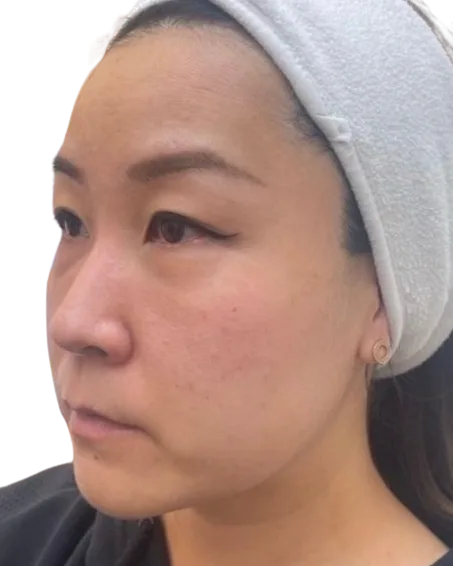
Case 1 · Tear Trough · Low Water-Absorption Superficial Refinement
- Ideal candidate profile
- Asian female · tear trough hollowing causing a tired appearance
- Concerns
- Under-eye hollowing and worsening dark circles
- Treatment plan
- Low-hydrophilic HA (Juvéderm® Volbella / Restylane® Vital) — small-volume precision filling above the periosteum
- Treatment outcomes
- Tear trough smoothed · Eyes look refreshed and rested
- Longevity
- 9–12 months
Case 01: The tear trough is a high-risk zone requiring a low water-absorption product and aspiration testing · Treatment led by our physician


Case 02 · Midface Volume / Apple Cheeks · Deep Structural Support
- Ideal candidate profile
- Asian women · Midface volume loss
- Concerns
- Flat midface / sunken cheeks creating an aged, hollowed appearance
- Treatment plan
- High G prime HA (Juvéderm® Voluma / Restylane® Lyft) — deep periosteal support
- Treatment outcomes
- Mid-face fullness and lift · nasolabial folds visibly softened
- Longevity
- 18–24 months
Case 02: High G-prime filler for deep structural support — one targeted placement to address multiple areas of volume loss · Performed by our physician
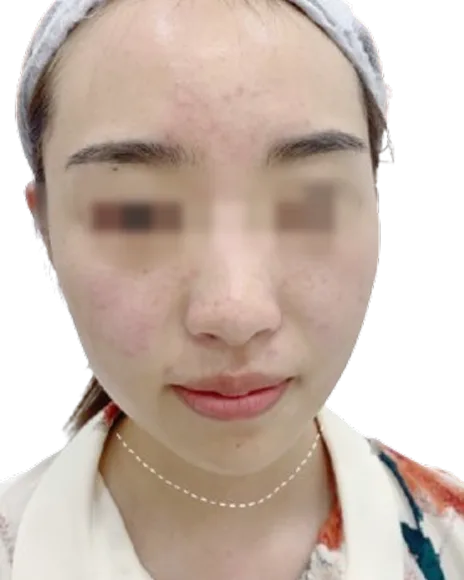
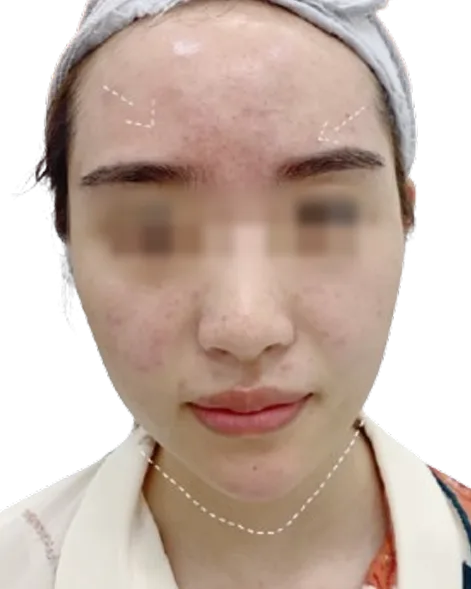
Case 03 · Recessed Chin · Contour Reshaping
- Ideal candidate profile
- Asian female · recessed chin, poorly defined profile
- Concerns
- Short chin and imbalanced lower facial third proportions
- Treatment plan
- High G-prime filler (Volux / Ultra Deep) for supraperiosteal chin contouring
- Treatment outcomes
- Smooth profile contour · balanced facial thirds
- Longevity
- 18–24 months
Case 03: Chin Augmentation for Improved Profile and Jawline Transition · Led by our physician
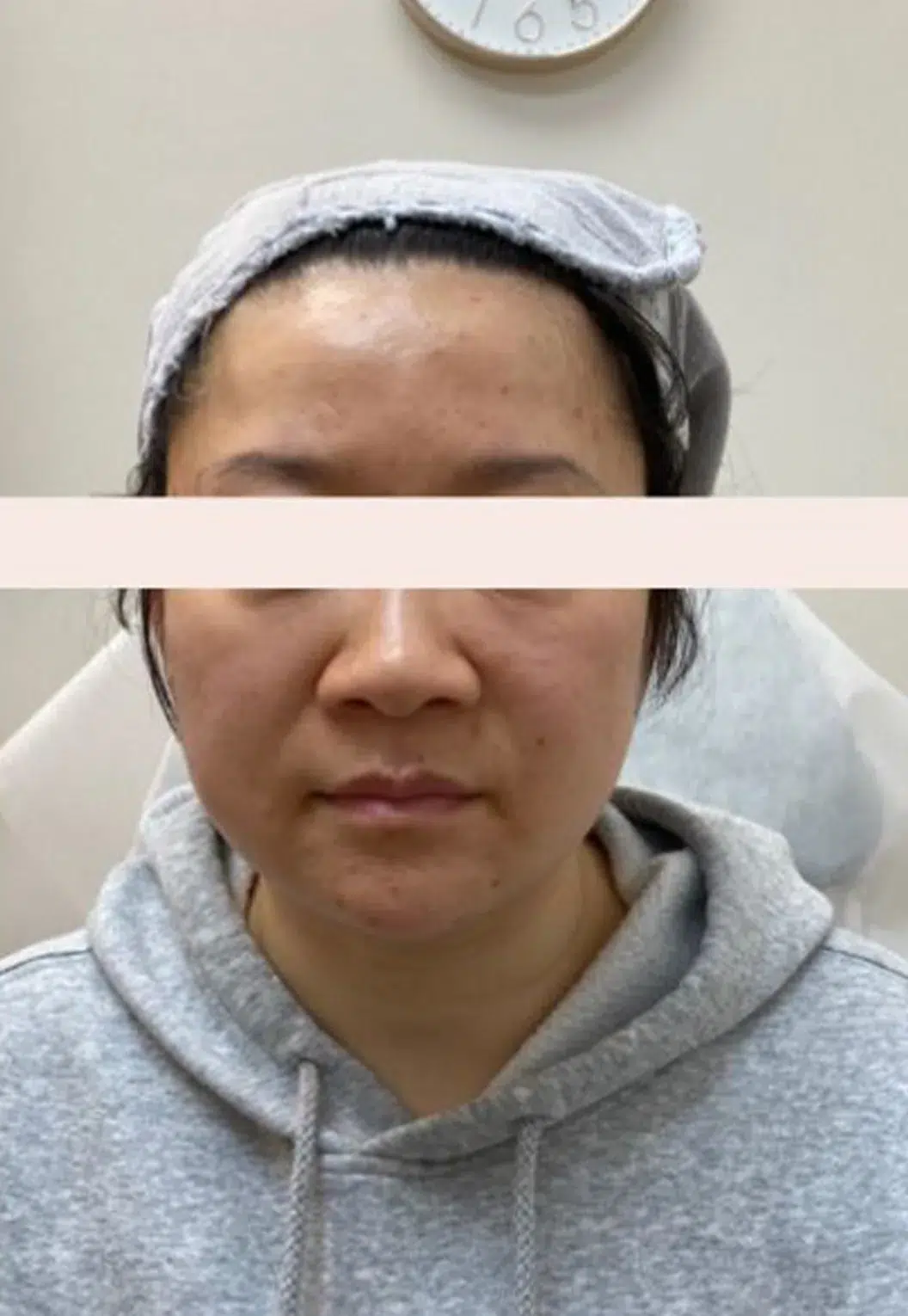
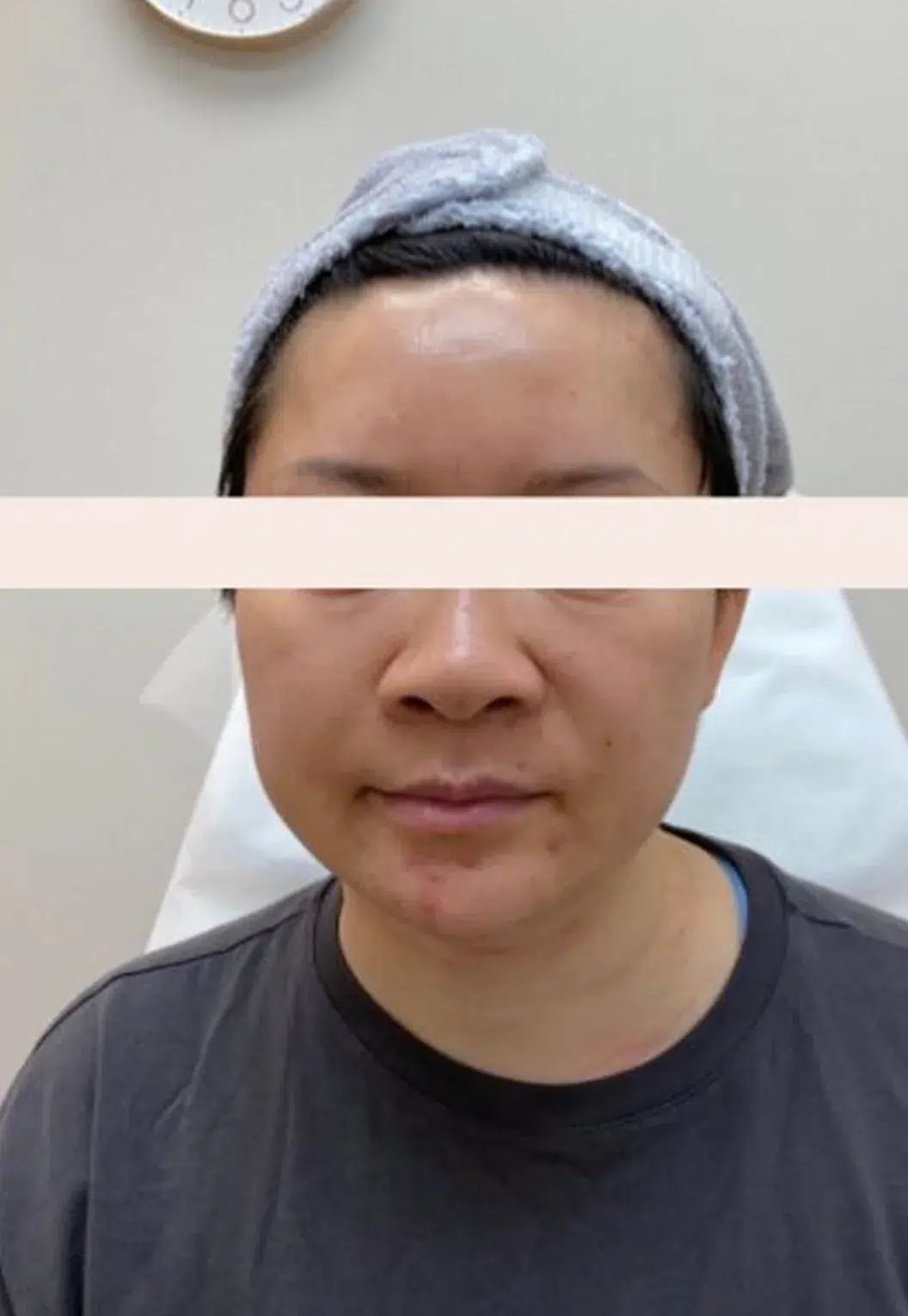
Case 04 · Temple / Forehead Hollowing · Upper Face Volume
- Ideal candidate profile
- Asian women · Temple hollowing creates a tired appearance
- Concerns
- Upper face volume loss and facial “Gaunt appearance that adds years”
- Treatment plan
- High-support HA filler for deep-layer temple volume restoration
- Treatment outcomes
- Fuller, softer upper face · overall more youthful and approachable appearance
- Longevity
- 18–24 months
Case 04: The temples are a high-risk zone requiring precise anatomical awareness and slow injection technique · Performed by our physician
Why Choose Luowei Medical Aesthetics Clinic for Dermal Fillers in Nanjing
The safety and natural appearance of dermal fillers depend on product selection, injection depth, and anatomical risk awareness. Our approach is built on three pillars: a full multi-brand product portfolio, a layered injection philosophy, and a rigorous vascular safety protocol.
Full multi-brand, multi-layer portfolio
Juvéderm / Restylane / Belotero / Teosyal / Yvoire / Stylage A comprehensive product range — from deep periosteal support to superficial refinement — allows product selection to be guided by clinical need, not “Only one option”.
Layered injection philosophy
Matching product to layer by G-prime and hydrophilicity — high G-prime for deep placement, low water-absorption for superficial refinement — helps avoid “overfilled yet unnatural-looking results”.
Vascular safety protocol
Aspiration testing, slow injection, anatomical risk avoidance, and readily available hyaluronidase work together to minimize the risk of vascular occlusion.
Dissolvable and adjustable
HA fillers can be dissolved with hyaluronidase and adjusted if results are unsatisfactory — this reversibility is the fundamental safety advantage over permanent fillers.
Asian facial aesthetics
Support points are designed around Asian bone structure and aesthetic sensibilities, aiming for “Natural lift” rather than “Instagram face” / overdone look “.
All consultations and injections performed personally by the physician
Treatment planning and injections are performed personally by our physician, including anatomical assessment and product selection.
- Full multi-brand, multi-layer dermal filler portfolio— Product selection individualized by area and injection depth
- Hyaluronidase always on hand— Vascular safety and reversibility assurance
What Are Dermal Fillers?
Dermal fillers are injectable treatments that restore volume, support facial structure, and refine static lines. They fall into two distinct categories that work by different biological mechanisms — and the choice between them is the single most important decision in filler treatment.
Hyaluronic acid (HA) fillers
Hyaluronic acid is a substance naturally present in the body, responsible for hydration and structural support. Medical-grade HA fillers use cross-linking technology to form gels of varying firmness and hydrophilicity, injected at specific tissue depths. NMPA-registered and reversible— dissolvable with hyaluronidase.
Collagen-stimulating (non-HA) fillers
Non-HA fillers stimulate the body’s own collagen production. They are longer-lasting, but most are irreversible— there is no dedicated dissolving agent. Product selection and injection depth therefore require greater care.
Materials and brands: CaHA — Radiesse®PLLA — Sculptra®PCL — Ellansé®PMMA — Bellafill®HA+CaHA hybrid — HArmonyCa®
Key points
- HA fillers Immediate volume · reversible · maintenance every 9–24 months depending on product and area
- Collagen stimulators Gradual or combined effect · longer-lasting · most are irreversible
- What fillers address Static concerns — hollowing, volume loss, established deep folds
- What fillers do not address Dynamic expression lines, which should be addressed with neuromodulators first
How HA Fillers Work
Dermal filler works by precisely injecting product into the appropriate tissue layer to physically restore volume or structural support; high G-prime formulas placed in the deep layer “Lift and support” mid-face volume restoration, which simultaneously improves nasolabial folds and other signs of facial descent. The key to safety lies in precise injection depth and careful vascular avoidance.
Consultation & Anatomical Assessment
Our physician assesses volume loss, skeletal support, and skin condition to determine which areas involve static hollowing and which may benefit from combination neuromodulator treatment. Our physician then designs a layered approach, selecting the appropriate products and injection depths for each zone.
Matching product to tissue layer
Product selection is guided by G-prime and hydrophilicity: high G-prime fillers for deep structural support, low water-absorption fillers for superficial refinement, and lip-specific formulas for the perioral area.
Anesthesia and vascular safety preparation
Most filler products contain lidocaine for added comfort. In high-risk anatomical zones, blunt cannulas, aspiration testing, and slow injection technique are used, with hyaluronidase on hand at all times.
Layered precision injection
Injections are performed in distinct layers — deep periosteal support, mid-layer transition, and superficial refinement. A conservative, incremental approach is used to build contour gradually, with symmetry and overall harmony assessed in real time.
Immediate Results & Follow-Up
Volumizing results are visible immediately; final contour settles once swelling subsides (approximately 1–2 weeks). A follow-up appointment for fine-tuning is available as needed.
The most serious risk of dermal filler is vascular occlusion — how we prevent it
Inadvertent intravascular injection into the facial artery, angular artery, or ophthalmic artery can cause skin necrosis or even permanent vision loss. High-risk zones include Glabella, tear trough, nose, and forehead. Safety depends on the injector’s anatomical expertise and adherence to clinical best practices.
Anatomical hazard avoidance
Thorough knowledge of facial vascular anatomy; blunt-tip cannulas used in high-risk zones to avoid danger planes
Aspiration + slow injection
Pre-injection aspiration testing and slow, low-pressure delivery to reduce the risk of intravascular injection
Hyaluronidase on standby
Hyaluronidase is always on hand — any irregularity is addressed immediately
How Non-HA Fillers Work
Each product works differently: CaHA and PCL provide immediate structural support while stimulating collagen production; PLLA relies primarily on gradual collagen regeneration over several months for volume restoration; PMMA delivers support through permanent microspheres — what they share is “stimulating the body’s own collagen” philosophy of long-lasting, lasting results.
Consultation & Anatomical Assessment
Our physician assesses volume loss, skeletal support, and skin condition to determine whether a long-lasting non-HA filler is appropriate — and whether a HA trial is the right first step.
Product selection
CaHA / PLLA / PMMA / PCL is selected based on the client’s desired longevity and treatment goals, with clear informed disclosure of each option’s characteristics.Irreversible characteristics and expected outcomes.
Safe injection practices
Most products contain lidocaine or can be used with topical anesthesia. In higher-risk areas, blunt cannulas are used together with aspiration testing and slow injection technique — delivering deep structural support in small, incremental amounts.
Gradual collagen-based volume enhancement
CaHA Structural support is visible immediately. PLLA builds volume naturally over several months as new collagen forms, and typically requires 2–3 staged treatment sessions.
Follow-up / maintenance
Follow-up assessments are scheduled according to each product’s duration; longer-lasting products require less frequent maintenance.
The key risk of non-HA fillers: no “reversing agent”
These fillers have no reversing agent — making it significantly more difficult to address shape irregularities or complications if they arise.Careful product selection, injection depth, and dosing, Starting with a reversible hyaluronic acid filler to confirm the desired shape before committing to an irreversible product is a key risk-reduction strategy.
Trial shaping first
First-time clients are advised to begin with a reversible hyaluronic acid filler to confirm their desired shape
Conservative dosing
small amounts per session to avoid over-correction that is difficult to address
Vascular avoidance
blunt cannula, aspiration, and slow injection in high-risk areas
Am I a Candidate for Dermal Filler?
You are welcome to do a self-assessment before your consultation; however, the final treatment plan and product selection require our physician to personally evaluate your volume loss, skeletal support, and any high-risk anatomical areas.
You may be a good candidate if…
- Volume loss in the cheeks / midface creating a hollow, aged appearance
- Tear trough hollowing and worsening under-eye darkness
- Recessed chin and poorly defined lateral facial profile
- Temple / forehead hollowing
- Static folds such as nasolabial folds and marionette lines
- Lip definition and perioral lines
- Seeking reversible, natural-looking volume restoration
Treatment is not recommended if any of the following apply…
- Pregnancy / breastfeeding
- Active infection or inflammation at or near the intended injection site
- Known allergy to hyaluronic acid or lidocaine
- Severe coagulation disorder or current use of strong anticoagulants (requires physician evaluation)
- Active autoimmune conditions (individual assessment required)
- Unrealistic expectations regarding outcomes
Different Concerns × Recommended Depth & Longevity
| Concerns | Depth / product | Longevity |
|---|---|---|
| Apple cheeks / midface | Deep layer, high G-prime (Voluma / Lyft) | 18–24 months |
| Nasolabial folds / marionette lines | Mid-layer (Vollure / RHA 3) | 12–18 months |
| Tear trough / fine lines | Superficial Layer, Low Water Absorption (Volbella) | 9–12 months |
| Chin / mandible | Deep Structural Support (Volux) | 18–24 months |
| Lips | Lip-specific formulas (Kysse / Volbella) | 9–12 months |
HA or Collagen-Stimulating — Which Is Right for You?
This is the decision your consultation exists to answer. Our physician assesses volume loss, skeletal support, and any high-risk anatomical zones before recommending a category, a product, and an injection depth.
HA is usually the starting point if…
You are new to fillers · you want a result you can adjust or reverse · the treatment area is high-risk anatomically · you want to see the shape before committing to something long-lasting.
A collagen stimulator may suit you if…
You already have HA filler experience · you prefer less frequent maintenance · you are seeking gradual, collagen-driven improvement · you need strong structural support in the chin, jawline, or temples.
How the two categories differ
- Onset HA: immediate · CaHA and PCL: immediate support plus collagen stimulation · PLLA: gradual over months
- Reversibility HA: dissolvable with hyaluronidase · Non-HA: no dissolving agent available
- Sessions HA: typically one session · PLLA: typically 2–3 separate sessions
- First-time patients Generally advised to start with HA, particularly in high-risk areas
Concerns Dermal Fillers Can Address
From deep structural support to superficial refinement, HA fillers address a broad range of facial volume and contouring concerns.
Mid-face / cheek volume loss
Deep structural support restores midface volume and simultaneously softens nasolabial folds.
18–24 monthly maintenance
Tear trough
Low water-absorption filler placed precisely to reduce hollowing and the appearance of dark circles.
9–12 monthly maintenance
Chin / jawline
High G-prime contouring improves the lateral profile and facial thirds proportions.
18–24 monthly maintenance
Temples / Forehead
Restoring upper face volume creates an overall softer, more youthful appearance.
18–24 monthly maintenance
nasolabial folds
Deep structural support combined with mid-layer transition to soften nasolabial fold creasing.
12–18 monthly maintenance
Marionette lines
Often best addressed with combination therapy: neuromodulator (depressor anguli oris) + dermal filler.
Combination therapy
Lip shape / Cupid’s bow
Lip-specific products for natural-looking fullness — defined, not overdone.
9–12 monthly maintenance
Nose refinement
High-risk zones requiring careful technique by an experienced physician.
Consultation assessment
Treatment goals × product layering × longevity guide
| Concerns | Recommended layer / product | Longevity |
|---|---|---|
| Apple cheeks / midface | Deep Layer (Voluma / Lyft) | 18–24 months |
| Tear trough | Superficial Layer, Low Water Absorption (Volbella) | 9–12 months |
| Chin / mandible | Deep Structural Support (Volux / Ultra Deep) | 18–24 months |
| nasolabial folds | Deep layer + mid-layer (Juvéderm® Vollure) | 12–18 months |
| Lips | Lip-Specific Products (Kysse / Volbella) | 9–12 months |
Treatment areas
Lip Filler Chin Filler Nose Filler Cheek Filler Temple Filler Forehead Filler Aegyo Sal Filler Tear Troughs Nasolabial Folds
Filler complication and correction: Filler Correction
Pre-Procedure Information · Injection Process · Post-Procedure Care
Dermal filler has minimal downtime, but proper post-procedure care helps reduce bruising and swelling and helps stabilize your results.
Pre-procedure preparation
- For one week before treatment, avoid aspirin, ibuprofen, fish oil, vitamin E, and other supplements that increase bruising risk (unless otherwise directed by your physician).
- Avoid alcohol for 24 hours before your treatment
- Avoid scheduling treatment within one week of an important event (to allow for any bruising or swelling to resolve).
- Disclose all current medications, known allergies, and previous filler history.
During the procedure
- Most products contain lidocaine for improved comfort during injection
- Blunt-tip cannula and/or aspiration testing with slow, low-pressure injection in high-risk zones
- Small amounts injected incrementally, with real-time assessment of symmetry and contour
- A single treatment session typically takes 20–45 minutes
Post-procedure care
- 24–48 Avoid strenuous exercise, saunas, and hot yoga for the specified number of hours after treatment
- Do not rub, press, or massage the treated area unless your physician instructs you to do so for shaping purposes.
- The lips and other high-movement areas may experience more noticeable swelling; cold compresses help reduce discomfort
- Bruising may be covered with concealer after 24 hours; final results are typically apparent within 2 weeks.
- If you experience severe pain, skin blanching, or any visual disturbance, contact the clinic immediately.
Recovery timeline
| Duration | Condition |
|---|---|
| D0 (same day) | Volume improvement is visible immediately; mild swelling and minor bruising at injection sites may occur |
| D1–D3 | Peak swelling and bruising, gradually subsiding |
| D4–D7 | Bruising largely resolved; shape becomes more stable |
| D14 | Swelling fully resolves and final natural results are visible; follow-up appointment available for fine-tuning if needed |
Advantages of Dermal Filler Treatment
Immediate results, reversible, and moldable — but natural-looking outcomes and safety depend entirely on product selection and the injector’s anatomical expertise.
Immediate results
Volumizing effects are visible immediately after injection.
Reversible
Adjustable and dissolvable with hyaluronidase.
Layered contouring
Full coverage from deep structural support to superficial refinement.
Minimal downtime
Bruising typically resolves within 1–3 days.
Lidocaine-enhanced comfort
Most products contain lidocaine.
Multi-brand
Product selection is matched to each specific treatment area.
Can be combined with
Synergistic anti-aging results when combined with Botox® and Thermage® FLX.
Associated lifting effect
Deep structural support to address signs of facial descent.
Dermal Filler vs. Other Fillers
| Filler | Ingredient / formulation | Reversible | Longevity |
|---|---|---|---|
| Hyaluronic Acid (HA) | cross-linked hyaluronic acid | Yes (hyaluronidase) | 9–24 months |
| Radiesse (Radiesse®) | Calcium hydroxylapatite (CaHA) | Not reversible | 12–18 months |
| Sculptra (Sculptra®) | Poly-L-lactic acid (PLLA) | Not reversible | 2 year(s)+ |
| Bellafill | PMMA Permanent microspheres | Not reversible | Permanent |
Reversibility is the most important safety advantage of hyaluronic acid filler — particularly for first-time treatments or high-risk anatomical zones.
Why Trust Luowei Medical Aesthetics Clinic for Your Dermal Filler Treatment?
Google's E-E-A-T framework evaluates medical content across four dimensions. The following credentials support every claim made on this page.
Real-world clinical experience
- 80,000 injectable procedures performed to date
- Comprehensive filler and correction across all facial layers
- Extensive experience managing filler complication revisions from other clinics
- Complete photographic records for every patient
- Expertise in facial vascular anatomy and tissue-plane knowledge
- Multi-brand product expertise and cross-brand dosage equivalence experience
Industry-recognized credentials
- Every medical claim on this page is anchored to a named, clickable source — see Evidence & references below
Transparent and verifiable
- NMPA-registered products only
- Hyaluronidase always on hand
The safety of dermal filler lies in the anatomy you cannot see
The same product injected into the wrong layer can cause swelling or migration; inadvertent intravascular injection can lead to tissue necrosis or even vision loss. The difference lies entirely in The physician’s mastery of facial vascular anatomy and tissue planes, and whether hyaluronidase is always kept on hand for emergency use.
Dermal Filler Pricing & Payment
Pricing varies by product brand, volume used (number of syringes), and treatment area.A personalized quote will be provided by our physician following your complimentary 30-minute consultation.
Priced per syringe / area · pricing varies by brand and depth of treatment
Multi-area and combination treatments priced per session
- Payment is made at the clinic, after the consultation and before treatment begins
- Nothing is paid in advance, and no deposit is required to hold an appointment
- Cosmetic treatment is a self-pay item and is not covered by public medical insurance in China
- All new clients receive a complimentary 30-minute Free Consultation & Assessment
Common Reactions · Serious Risks · Contraindications
Transparency in medical aesthetics is itself a mark of expertise and trustworthiness. We openly share all potential reactions, serious risks, and contraindications so that you are fully informed before your consultation.
Common reactions (approximately 30% of patients, typically short-lived)
- Pinpoint bruising (resolves within a few days; can be covered with concealer)
- Mild swelling (1–3 days (more pronounced in the lip area)
- Tenderness / tightness (a few days to settle)
- Temporary irregularities / small nodules (most can be resolved with massage or will improve over time)
Serious Risks (rare < 0.05%, but important to disclose)
- Vascular occlusion— Accidental injection into the facial artery, angular artery, or ophthalmic artery can cause skin necrosis or vision loss. High-risk zones include the glabella, tear trough, nose, and forehead. Risk is minimized through aspiration testing, slow low-pressure injection, thorough anatomical knowledge to avoid danger zones, and having hyaluronidase immediately on hand.
- Delayed granuloma / nodule formation— Rare immune reaction
- Infection— Rare; sterile technique minimizes risk
- Allergy— Known allergy to filler components or lidocaine
Absolute Contraindications (treatment not performed)
- Pregnancy / breastfeeding
- Active infection or inflammation at or near the intended injection site
- Known allergy to hyaluronic acid or lidocaine
- Significant coagulation disorders (individual assessment required)
- Active autoimmune conditions (individual assessment required)
Common Reactions · Serious Risks · Contraindications
Transparency in aesthetic medicine is a mark of genuine expertise. We openly share all possible reactions, serious risks, and contraindications so you arrive at your consultation fully informed.
Common reactions (may occur in the short term)
- Injection-site bruising / mild swelling (1–3 days)
- Tenderness / tightness (several days)
- temporary irregularities (often manageable with massage)
Serious Risks (rare but must be disclosed)
- Vascular occlusion— Inadvertent intravascular injection can lead to skin necrosis or vision loss; aspiration, slow injection, and thorough anatomical knowledge are essential to minimizing this risk.
- nodules / granulomas— PLLA Improper massage technique or individual tissue response may cause CaHA / PMMA to
- Irreversible shape irregularities— No dissolving agent available; correction is challenging
- Infection— Rare; minimized with strict aseptic technique
Absolute contraindications / requires assessment (not performed)
- Pregnancy / breastfeeding
- active infection or inflammation at the injection site
- Allergy to filler components
- keloid-prone skin (use caution with PMMA)
- Active autoimmune conditions (evaluation required)
Where the medical claims on this page come from
Everything above about Dermal Fillers rests on published evidence rather than on our own word. The sources below are the ones behind those statements: peer-reviewed papers indexed in PubMed, and guidance written for patients by dermatology academies and national health services. Read them before you decide — and bring any of them to your consultation.
- Peer-reviewedHyaluronic Acid Dermal Filler-Associated Vascular Occlusion-A Review of Prevention and Management Strategies
- Peer-reviewedHyaluronidase for Dermal Filler Complications: Review of Applications and Dosage Recommendations
- Patient guidanceDermal fillers: Overview
- Patient guidanceFillers: FAQs
What these references can and cannot tell you. They describe what is known about the treatment itself — how well it tends to work, how long results last, and what can go wrong. They are not an assessment of this clinic, and no published study can tell you whether it suits your skin type, anatomy, or medical history. That judgement comes from the physician who examines you in person, and it may well be “not this one”.